
PrePool Methodology

PrePool Methodology
Most companies start technical hiring with a specific vacancy: publish a job, collect applications, filter them, and identify relevant candidates. Upstaff uses a different sequence: sourcing and pre-screening take place before a specific client requirement appears. This approach is called the Pre-Screened Talent Pool (PrePool).Where the Candidate Pool Comes From
PrePool sourcing deliberately combines multiple sources rather than relying on incoming applications:- LinkedIn Recruiter
- Boolean search via Google and X
- Coresignal
- Proprietary web-profile collection
- GitHub
- Local job boards and candidate databases
- Professional communities and social groups
The R&D Engineering Talent Market in 2026
Upstaff estimates that the addressable R&D-oriented engineering market across its primary sourcing regions exceeds 5 million people. This is an internal market estimate rather than an official statistical measure. It is narrower than the broader ICT specialist category used by European agencies (Eurostat reported 10.45 million ICT specialists in the EU in 2025).RND Market distribution by location
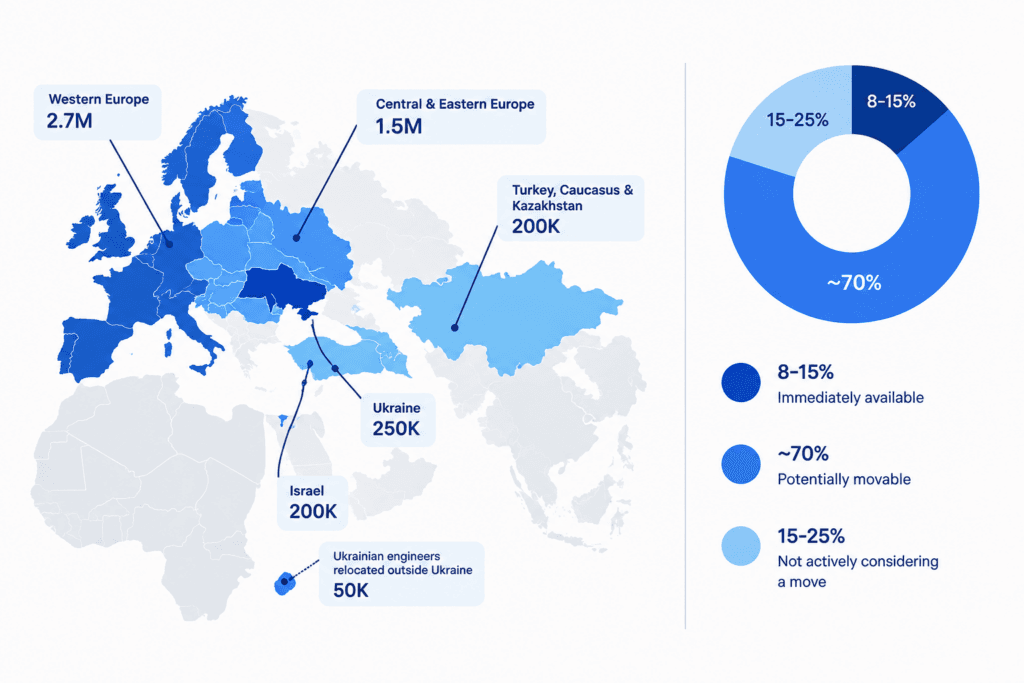
- Central & Eastern Europe — 1.5M
- Western Europe — 2.7M
- Turkey, Caucasus & Kazakhstan — 200K
- Israel — 200K
- Ukraine — 250K
- Ukrainian engineers relocated outside Ukraine — 50K
Availability Within the Market
The engineering market can be divided into three groups (Upstaff market model, not official labour-market statistics):- 8–15% — Immediately available Actively looking, between projects, on a bench, or otherwise ready to start relatively quickly. For a 5M+ market this corresponds to a potential pool of up to ~750,000 people.
- ~70% — Potentially movable Employed but open to the right opportunity. Upstaff estimates this segment at approximately 70% of the addressable market, or up to roughly 3.5 million engineers. These engineers are largely invisible to pure application-based recruiting. Their willingness depends on compensation, technical challenge, product, engineering culture, remote arrangements, career progression, stack, and international exposure. This is the group we can actively compete for — especially when a client can make an offer meaningfully better than the market median (“dream job”).
- 15–25% — Not actively considering a move Satisfied, committed, or simply not interested in changing jobs under ordinary conditions.
Screening Before a Specific Job Exists
Conventional processes screen candidates against a particular job description. PrePool screening happens earlier. Upstaff periodically interviews engineers based on expected demand for technologies, seniority levels and engineering functions — even when there is no active client requirement for Senior Backend, Staff Data Engineering, React, Machine Learning, DevOps, Solution Architecture, etc. As of 2026 the Upstaff PrePool contains 2,000+ engineers who have already been screened by independent Upstaff experts. This information is then used the moment a client requirement appears.Application Optimisation and ATS Filtering
Tools that help candidates tailor application materials to individual vacancies are now widely available. Services such as: analyse job descriptions, surface keywords and assist with resume tailoring (including AI-assisted rewriting aimed at ATS compatibility). An AI-assisted CV is not automatically inaccurate. It does mean the document an employer sees increasingly reflects a candidate’s ability to optimise an application in addition to their underlying experience. This becomes material when a hiring process relies heavily on keyword matching.Automated Job Applications (Auto-Submit Services)
Automation has moved beyond resume optimisation. Several services can search for vacancies and submit applications automatically or semi-automatically on the candidate’s behalf. Examples include: These systems increase application volume. From the employer side the result is often higher numbers without a proportional increase in relevant candidates. Some of these tools are designed to work around or through common protections on LinkedIn Jobs, Greenhouse and other ATS career pages, further increasing the volume of low-relevance applications that reach the system. The recruiting workflow therefore has to separate application volume from candidate relevance.ATS Systems and the Filtering Layer
Large organisations commonly use ATS and recruiting platforms such as: These systems provide applicant tracking, workflow management, screening and reporting. They process large volumes efficiently. However, the information entering the ATS is still supplied by candidates. When candidates use multiple resume versions, keyword optimisation, AI-generated answers or automated submissions, the ATS is processing increasingly optimised application data. The ATS can make the process more efficient. It does not independently verify whether every claim accurately reflects the candidate’s practical experience. That remains a screening and assessment task.Interview Volume in Technical Hiring
The cost of hiring is not limited to sourcing. Each candidate who reaches the interview stage consumes time from recruiters, engineers and hiring managers. Ashby’s recruiting data reports approximately 17.6 applicants interviewed per hire for technical roles, with a median technical interview process of ~17.9 days from first to last interview. Gem’s 2025 recruiting benchmark (based on more than 140 million applications) reported approximately 20 interviews per hire — a 42% increase compared with 2021. These figures count interview events, not unique candidates. A process involving 6–10 candidates who each go through 2–4 stages routinely produces 15–20+ interview events. The workload includes technical interviewers, hiring managers, team members, scheduling, feedback collection and decision-making.Sourcing Cost
To successfully fill one senior IT vacancy, a average European talent acquisition team typically needs to source and screen 100 to 200 candidate profiles. Upstaff team typically reviews 500-1,000 profiles. Cost-per-application examples, € (highly variable by role, geography, and competition):- €2.5–€8: LinkedIn tech roles:
- €5–€25: Indeed:
- €8–€20: Tech average:
| Cost component | Internal benchmark |
| Job advertising placement/sourcing budget | €1,000–€3,500 |
| Recruiter time | €1,200–€3,500 |
| Recruiter and technical interviewer effort | ~30–50 hours |
| Combined sourcing cost | ~€3,000–€7,000 |
What PrePool Changes
The operational difference is that part of the screening process occurs before a client requirement is received.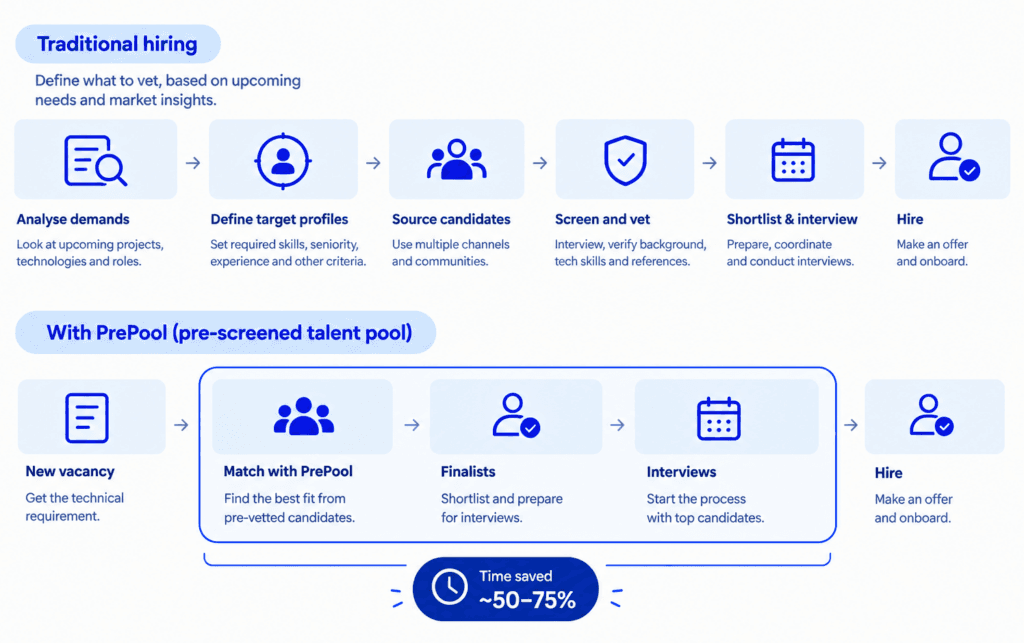 When a requirement arrives, available information may already include technical experience, previous projects, professional history, screening results, communication assessment, technology exposure and availability. The new requirement is then used to identify which previously screened engineers are relevant and where additional sourcing is needed.
Screening Without a Specific JD
When a candidate is screened before a specific vacancy exists, the interviewer does not have the client’s detailed job description in front of them. Evaluation can focus on what the engineer has actually done rather than on whether the profile contains the exact terminology of one particular vacancy. In simplified form:- What has this engineer actually done?
- How relevant is that experience to this particular technical challenge?
From Resume Matching to Technical Matching
Upstaff’s workflow:- Understand the technical requirement — not just the job title or career-page text. What needs to be built or changed? Existing architecture? Ownership? Genuine technology requirements? Transferable experience? Team structure? Required autonomy?
- Define the target profile — capabilities, relevant experience, seniority, domain exposure, team context, communication requirements, availability, compensation range.
- Search the existing pool and the wider market — PrePool + new sourcing + automated search + human review.
- Human-first finalist review — candidates identified by automated search are reviewed by people before being presented. The goal is to determine whether the candidate’s actual background matches the technical requirement, not merely whether the resume contains matching keywords.
PrePool and KYD
PrePool and KYD address different parts of the process.- PrePool maintains a continuously sourced and screened talent pool.
- KYD (Know Your Developer) establishes confidence in a particular engineer’s professional history, references, technical background and other verification signals.
Current PrePool Metrics (Upstaff internal)
| Metric | Figure |
| Addressable R&D engineering market | 5M+ |
| Pre-screened engineers | 2,000+ |
| Average finalists presented per job | ~3.5 |
| Jobs closed | 93% |
| Average engagement value | $7K |
| Countries covered | X+ |
What Has Changed in Technical Recruiting
Several parts of the process are becoming increasingly automated on both sides: Candidates- AI-assisted resume writing
- JD-specific keyword optimisation
- Automated application generation and submission
- Automated job discovery
- ATS filtering and ranking
- AI-assisted sourcing
- Automated scheduling and interview analytics
Sources
- Novoresume Resume Report 2026 (AI usage in resumes)
- Ashby Talent Trends and Gem Recruiting Benchmarks (interview volume)
- Upstaff internal analytics and market benchmarks for LinkedIn / Indeed sourcing costs and CPA (2025–2026)
- Upstaff · Know Your Developer (KYD)