'%3e%3cpath%20d='M0%2040.9959H9.00413V50H0V40.9959ZM0%2040.9959H9.00413V50H0V40.9959ZM0%2027.3306H9.00413V36.3348H0V27.3306ZM0%2013.6653H9.00413V22.6694H0V13.6653ZM0%200H9.00413V9.00408H0V0ZM13.2332%2040.9959H50V50H13.2332V40.9959ZM13.2332%2040.9959H50V50H13.2332V40.9959ZM13.2332%2027.3306H50V36.3348H13.2332V27.3306ZM13.2332%2013.6653H50V22.6694H13.2332V13.6653ZM13.2332%200H50V9.00408H13.2332V0Z'%20fill='%232049d8'/%3e%3c/g%3e%3cdefs%3e%3cclipPath%20id='clip0_2_8'%3e%3crect%20width='50'%20height='50'%20fill='white'/%3e%3c/clipPath%3e%3c/defs%3e%3c/svg%3e)


Want to hire .Net Maui developer?
Introduction
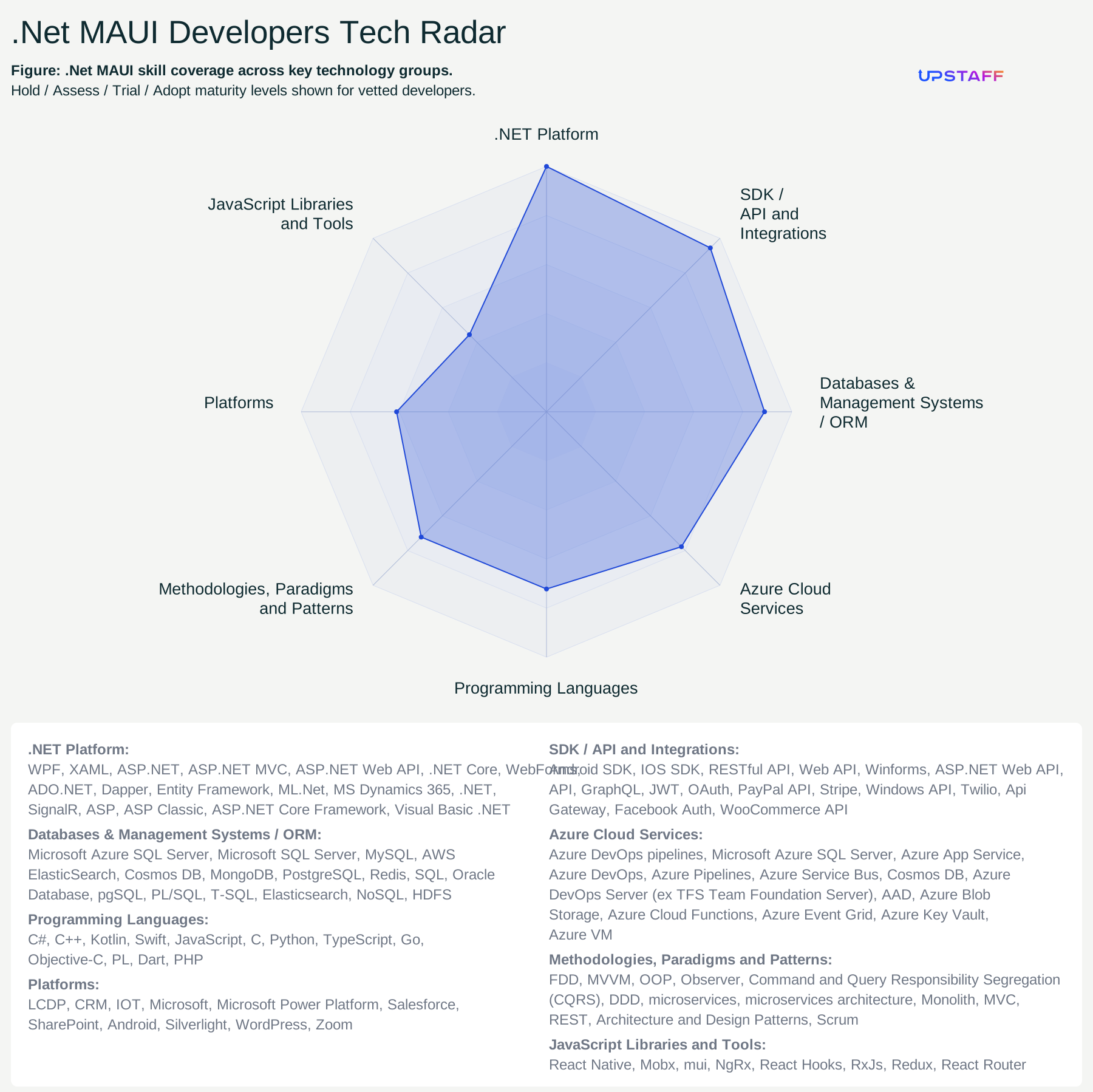
.NET MAUI emerged as the official successor to Xamarin.Forms, unifying mobile and desktop development under the modern .NET platform. In 2026 it remains the primary Microsoft-backed way to ship native experiences across Android, iOS, Windows and macOS from one C# codebase. This page examines the role of .NET MAUI developers, their technical demands, and their place in contemporary product teams. At Upstaff we maintain a roster of such experts, seasoned practitioners, not temporary contractors, ready to build or modernize cross-platform applications. We match them precisely to your requirements.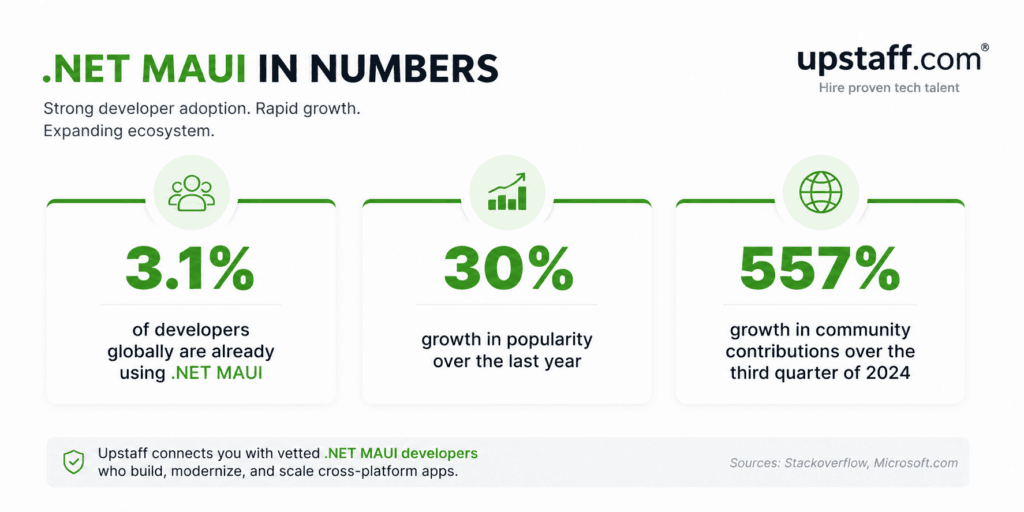
What is .NET MAUI Development?
.NET MAUI developers create high-performance native applications using C# and XAML (or C# markup). They design shared UI layouts, implement MVVM or other architectures, write platform-specific code when needed via handlers or partial classes, integrate device capabilities (camera, biometrics, sensors, notifications), and ship to multiple app stores. In 2026 the focus is on clean architecture, excellent performance, accessibility, and seamless migration from legacy Xamarin.Forms codebases.Role in Contemporary Development
.NET MAUI developers excel wherever organizations want one team to own mobile + desktop experiences instead of maintaining separate native codebases. They modernize Xamarin apps, build enterprise internal tools, consumer apps, and hybrid solutions (including Blazor Hybrid). They sit at the intersection of .NET backend skills and front-end craftsmanship.Key Competencies
 .NET MAUI developers must master:
- C# and .NET (latest LTS and current versions)
- XAML / C# Markup and the MAUI control set
- MVVM, dependency injection, messaging, and CommunityToolkit.Mvvm
- Handlers and custom controls (the modern replacement for custom renderers)
- Platform APIs and conditional compilation
- Data & storage (SQLite, EF Core, secure storage)
- Networking (HttpClient, Refit, gRPC, SignalR)
- Testing, CI/CD, and store deployment
- Tools: Visual Studio / VS Code, .NET CLI, MAUI Community Toolkit, Syncfusion / Telerik / DevExpress component suites when required
Why .NET MAUI Developers Matter
Organizations that already live in the Microsoft ecosystem gain massive leverage: shared business logic with ASP.NET backends, unified authentication (Entra ID / Azure AD), and lower long-term maintenance costs. In 2026 many teams are actively migrating Xamarin.Forms projects to MAUI or starting green-field multi-platform products. Skilled .NET MAUI developers shorten time-to-market and reduce the risk of platform-specific technical debt.Why Xamarin-to-.NET MAUI Migration Is One of the Biggest Mobile Modernization Projects
With Xamarin reaching end-of-life, the best way to ensure your app remains functional and future-proof is to migrate to its successor, .NET MAUI. When .NET MAUI was released in 2022, it was still rather rough, which led to misconceptions about its performance and ability to support large-scale applications.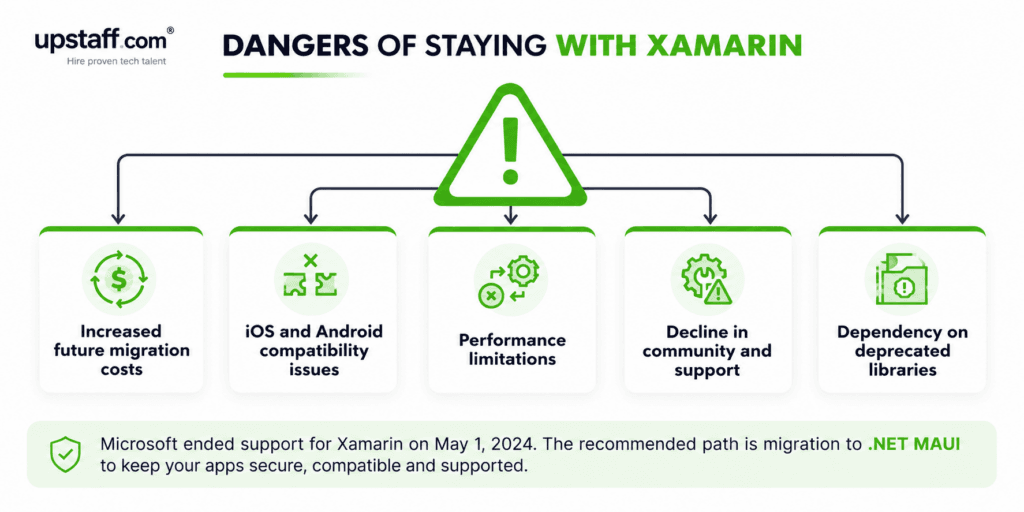 .NET MAUI isn’t just a replacement for Xamarin.Forms, but a significant evolution of cross-platform development within the .NET ecosystem. It has already surpassed its predecessor in popularity, with 3.1% of developers using .NET MAUI compared to 2.9% for Xamarin. This growth is unsurprising, as .NET MAUI streamlines the development process by allowing developers to create native user interfaces for Android, iOS, macOS, and Windows using a single shared codebase.
The demand for .NET MAUI developers is driven not only by new mobile applications, but by a much larger challenge: migrating existing Xamarin projects. Microsoft officially ended support for Xamarin and Xamarin.Forms on May 1, 2024, making .NET MAUI the recommended upgrade path for all supported cross-platform applications.
This has created a global modernization wave. Thousands of enterprise and commercial mobile apps built over the last decade on Xamarin still power internal business systems, customer portals, logistics, healthcare, retail, and fintech products. While these applications continue to run, they no longer receive framework updates, security fixes, or support for the latest Android and iOS platform changes.
The good news is that migration is not usually a full rewrite. In many cases, business logic, application architecture, and a significant part of the shared codebase can be preserved. The migration typically focuses on upgrading the project structure, replacing incompatible dependencies, adapting platform-specific code, and moving the application to the modern .NET MAUI architecture. Microsoft even provides dedicated migration tools and guides, although most production applications still require manual engineering work beyond the automated upgrade.
.NET MAUI isn’t just a replacement for Xamarin.Forms, but a significant evolution of cross-platform development within the .NET ecosystem. It has already surpassed its predecessor in popularity, with 3.1% of developers using .NET MAUI compared to 2.9% for Xamarin. This growth is unsurprising, as .NET MAUI streamlines the development process by allowing developers to create native user interfaces for Android, iOS, macOS, and Windows using a single shared codebase.
The demand for .NET MAUI developers is driven not only by new mobile applications, but by a much larger challenge: migrating existing Xamarin projects. Microsoft officially ended support for Xamarin and Xamarin.Forms on May 1, 2024, making .NET MAUI the recommended upgrade path for all supported cross-platform applications.
This has created a global modernization wave. Thousands of enterprise and commercial mobile apps built over the last decade on Xamarin still power internal business systems, customer portals, logistics, healthcare, retail, and fintech products. While these applications continue to run, they no longer receive framework updates, security fixes, or support for the latest Android and iOS platform changes.
The good news is that migration is not usually a full rewrite. In many cases, business logic, application architecture, and a significant part of the shared codebase can be preserved. The migration typically focuses on upgrading the project structure, replacing incompatible dependencies, adapting platform-specific code, and moving the application to the modern .NET MAUI architecture. Microsoft even provides dedicated migration tools and guides, although most production applications still require manual engineering work beyond the automated upgrade.Upstaff’s Contribution
Upstaff doesn’t outsource, we have .NET MAUI developers on our roster who have shipped production apps and completed real Xamarin-to-MAUI migrations. Looking to hire .NET MAUI developers? We pair you with talent that fits your stack, domain, and timeline. Solo specialist or full squad: we have range. Upstaff.com is the place, straight to the point.Related technologies
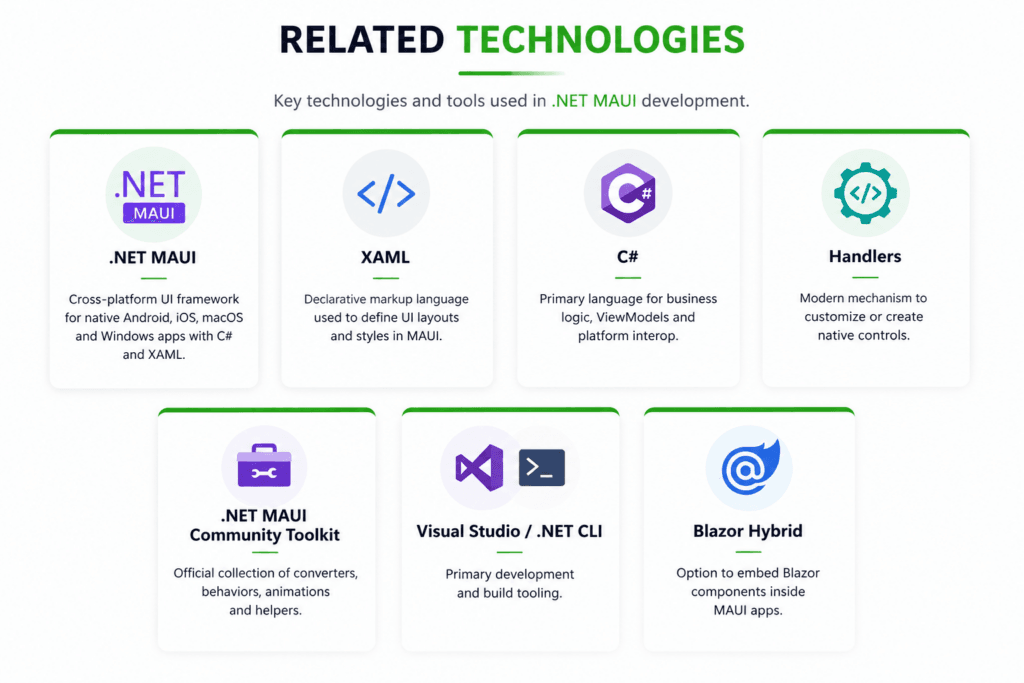
- .NET MAUI
Cross-platform UI framework for native Android, iOS, macOS and Windows apps with C# and XAML. - XAML
Declarative markup language used to define UI layouts and styles in MAUI. - C#
Primary language for business logic, ViewModels and platform interop. - Handlers
Modern mechanism to customize or create native controls. - .NET MAUI Community Toolkit
Official collection of converters, behaviors, animations and helpers. - Visual Studio / .NET CLI
Primary development and build tooling. - Blazor Hybrid
Option to embed Blazor components inside MAUI apps.
How and where is .NET MAUI used?
| Case Name | Case Description |
|---|---|
| Cross-platform mobile & desktop apps | Build a single codebase that runs natively on Android, iOS, Windows and macOS, delivering consistent branding while respecting platform conventions. |
| Xamarin.Forms to .NET MAUI migration | Upgrade legacy Xamarin applications to the modern MAUI stack, improving performance, tooling support and long-term maintainability. |
| Enterprise internal tools & LOB apps | Create secure, offline-capable line-of-business applications that share authentication and data layers with existing .NET backends. |
| Consumer & retail apps | Deliver high-performance storefront, booking or content apps with rich UI, camera/QR integration, push notifications and in-app purchases. |
| Hybrid solutions (Blazor Hybrid) | Combine native MAUI shells with Blazor web components for rapid UI iteration while keeping full access to device APIs. |
What are top .NET MAUI instruments and tools?
- Visual Studio 2022 / Visual Studio Code
Primary IDEs with full MAUI workload, Hot Reload, and multi-target debugging. - .NET CLI (dotnet new maui)
Project scaffolding, build and publish from the command line. - .NET MAUI Community Toolkit
Behaviors, converters, animations, MediaElement, and dozens of productivity helpers. - Handlers & Graphics
Low-level customization and SkiaSharp / Microsoft.Maui.Graphics for custom drawing. - Component suites
Syncfusion, Telerik, DevExpress, UX Divers for enterprise-grade controls. - Testing & CI
xUnit / NUnit, Appium or MAUI-specific UI testing, GitHub Actions / Azure DevOps pipelines, Fastlane for store deployment. - Azure & Microsoft ecosystem
Easy integration with Azure App Services, Notification Hubs, Cosmos DB, Cognitive Services and Entra ID.
TOP Tech facts and history of creation and versions about .NET MAUI Development
- .NET MAUI is the official evolution of Xamarin.Forms, announced as part of the .NET unification effort.
- First stable release shipped with .NET 6 (2021/2022 timeframe); continuous improvements with every .NET major version.
- Single project structure (unlike the multi-project Xamarin.Forms setup) dramatically simplifies solution management.
- Native performance via platform handlers rather than the older renderer model.
- Full support for the latest .NET features, AOT compilation options, and trimming for smaller app sizes.
- Active open-source development on GitHub (dotnet/maui) with strong community contributions.
- In 2025–2026 continued focus on Hot Reload improvements, Shell routing enhancements, passkeys, and deeper desktop (multi-window, menu bars) capabilities.
Find a .NET MAUI Engineer for Hire on Upstaff
We know you’re tired of looking for a skilled .Net MAUI developer. But that’s about to change because you’ve come across Upstaff. Working with the platform, you get:- Access to an international pool of talent.
- Assistance from our HRs in identifying candidates.
- Up to 5 days of waiting for the perfect specialist for your project.
- A guarantee of the quality of services of the hired contractor.
- No additional fees.
Talk to Our Expert
Our journey starts with a 30-min discovery call to explore your project challenges, technical needs and team diversity.

Yaroslav Kuntsevych
co-CEO