
'%3e%3cpath%20d='M0%2040.9959H9.00413V50H0V40.9959ZM0%2040.9959H9.00413V50H0V40.9959ZM0%2027.3306H9.00413V36.3348H0V27.3306ZM0%2013.6653H9.00413V22.6694H0V13.6653ZM0%200H9.00413V9.00408H0V0ZM13.2332%2040.9959H50V50H13.2332V40.9959ZM13.2332%2040.9959H50V50H13.2332V40.9959ZM13.2332%2027.3306H50V36.3348H13.2332V27.3306ZM13.2332%2013.6653H50V22.6694H13.2332V13.6653ZM13.2332%200H50V9.00408H13.2332V0Z'%20fill='%232049d8'/%3e%3c/g%3e%3cdefs%3e%3cclipPath%20id='clip0_2_8'%3e%3crect%20width='50'%20height='50'%20fill='white'/%3e%3c/clipPath%3e%3c/defs%3e%3c/svg%3e)


What is an LLM Engineer?
 LLM Engineers are specialized professionals who design, develop, and deploy Large Language Models (LLMs) like BERT (Google, 2018), LLaMA (Meta AI, 2023), and GPT (OpenAI, 2018-2023) to power advanced AI applications. Combining expertise in machine learning, natural language processing (NLP), and software engineering, they create models that generate human-like text, automate tasks, and enhance decision-making. Using toolkits like PyTorch, Hugging Face, and AWS, LLM Engineers tackle tasks from training billion-parameter models to building intelligent agents, serving industries like tech, healthcare, finance, and more.
At Upstaff, we help you find LLM Engineers with niche expertise, armed with the right toolkits to leverage models like BERT for semantic understanding or LLaMA for efficient research applications. Whether you need to hire an LLM Engineer for semantic data pipelines, real-time inference, or autonomous agent development, our platform offers access to professionals across 16 specialized roles. Below, we detail these roles, their responsibilities, and toolkits to help you find the ideal candidate.
LLM Engineers are specialized professionals who design, develop, and deploy Large Language Models (LLMs) like BERT (Google, 2018), LLaMA (Meta AI, 2023), and GPT (OpenAI, 2018-2023) to power advanced AI applications. Combining expertise in machine learning, natural language processing (NLP), and software engineering, they create models that generate human-like text, automate tasks, and enhance decision-making. Using toolkits like PyTorch, Hugging Face, and AWS, LLM Engineers tackle tasks from training billion-parameter models to building intelligent agents, serving industries like tech, healthcare, finance, and more.
At Upstaff, we help you find LLM Engineers with niche expertise, armed with the right toolkits to leverage models like BERT for semantic understanding or LLaMA for efficient research applications. Whether you need to hire an LLM Engineer for semantic data pipelines, real-time inference, or autonomous agent development, our platform offers access to professionals across 16 specialized roles. Below, we detail these roles, their responsibilities, and toolkits to help you find the ideal candidate.Key LLM Engineer Roles & Specializations
Below is a structured overview of the most in-demand LLM Engineer roles. Each includes core responsibilities, typical toolkits, and the business value of hiring that specialist.| Role | Main Responsibilities | Key Toolkits & Technologies | Why Hire This Specialist |
|---|---|---|---|
| LLM Training Engineer | Designs and manages large-scale training pipelines for models like GPT or LLaMA. Optimizes compute resources, hyperparameters, and massive datasets. | PyTorch, TensorFlow, DeepSpeed, Horovod, NVIDIA GPUs, AWS SageMaker | Build robust, high-performance LLMs efficiently while controlling training costs. |
| LLM Fine-Tuning Specialist | Customizes pre-trained models (BERT, LLaMA, etc.) for specific domains such as legal, medical, or finance. | Hugging Face Transformers, Datasets, PEFT (LoRA/QLoRA), Python, Jupyter Notebooks | Quickly adapt general models to your industry or use case with high accuracy. |
| LLM Inference Optimization Engineer | Optimizes models for low-latency, cost-effective inference on cloud or edge devices. | ONNX, TensorRT, Triton Inference Server, Kubernetes, Edge TPU | Deliver fast, scalable, and affordable LLM-powered applications in production. |
| Prompt Optimization Specialist | Crafts and tests advanced prompts to maximize output quality, coherence, and task performance. | LangChain, PromptTools, Python, OpenAI API, Anthropic Claude | Significantly improve response quality without retraining the model. |
| LLM Evaluation Specialist | Builds evaluation frameworks, runs red-teaming, measures performance, and identifies biases or weaknesses. | BLEU, ROUGE, Perplexity, HumanEval, Python, Pandas | Ensure your LLM is accurate, reliable, and production-ready. |
| LLM Safety & Alignment Engineer | Implements safety measures, RLHF, adversarial testing, and ethical alignment to prevent harmful outputs. | SafeRLHF, TRL (Transformers Reinforcement Learning), Python, EthicML | Deploy responsible AI that meets regulatory and ethical standards. |
| LLM Data Engineer | Builds robust data pipelines and curates high-quality semantic datasets (including knowledge graphs). | Apache Spark, Neo4j, RDF/SPARQL, AWS Glue, Airflow | Feed your models with clean, rich, and compliant training data. |
| Multimodal LLM Engineer | Develops models that combine text with images, audio, or video (e.g., vision-language models). | CLIP, LLaVA, Hugging Face Multimodal, PyTorch, OpenCV | Create advanced AI applications that understand multiple data types. |
| LLM Deployment Engineer | Deploys LLMs into production environments with focus on scalability, monitoring, and reliability. | AWS, Azure, Kubernetes, Docker, FastAPI, Prometheus | Seamlessly integrate LLMs into your existing systems and infrastructure. |
| LLM Research Scientist | Experiments with novel architectures, prototypes new techniques, and pushes the boundaries of LLM capabilities. | JAX, PyTorch, TensorFlow, research papers (ArXiv) | Drive innovation and keep your AI capabilities ahead of the competition. |
| Conversational AI Developer | Builds natural, engaging dialogue systems and chat experiences powered by LLMs. | RASA, Dialogflow, LangChain, Python, Flask | Create intuitive and human-like conversational interfaces for users. |
| LLM Compression Specialist | Reduces model size and resource requirements through distillation, quantization, and pruning. | TensorFlow Lite, DistilBERT, ONNX, Edge TPU, NVIDIA Jetson | Run powerful LLMs efficiently on resource-constrained devices or at lower cost. |
| LLM Bias & Fairness Specialist | Audits models for biases and implements debiasing techniques to ensure fair outputs. | Fairlearn, Aequitas, Python, Pandas, EthicML | Build inclusive and trustworthy AI solutions that serve diverse users. |
| Synthetic Data Generation Specialist | Creates high-quality synthetic datasets to augment training, especially in low-resource or sensitive domains. | Snorkel, Faker, GPT-based generators, Python, NumPy | Overcome data scarcity and improve model performance in niche areas. |
| LLM Performance Analyst | Monitors production LLMs, analyzes latency/quality issues, and recommends optimizations. | Grafana, Prometheus, ELK Stack, Datadog, Python | Keep your LLM systems fast, stable, and continuously improving. |
| LLM Agent Developer | Builds autonomous AI agents capable of tool use, planning, and multi-agent collaboration. | LangChain, AutoGen, LlamaIndex, CrewAI, Python, REST APIs | Develop intelligent agents that can execute complex, real-world tasks autonomously. |
Specialized Expertise: Document Intelligence & Enterprise RAG
LLM Engineers skilled in document intelligence excel at transforming unstructured documents (PDFs, scans, forms, reports) into reliable, searchable knowledge bases for accurate RAG systems and generative AI applications.| Expertise Area | Key Capabilities |
|---|---|
| A) OCR, Ingestion & Deduplication | • Layout-aware OCR for complex tables, forms, and handwriting • Multi-engine OCR stacks (Tesseract, ABBYY, Google Document AI, Azure Form Recognizer, PaddleOCR) • Accurate table extraction and structure reconstruction • Document deduplication using SimHash, MinHash, and perceptual hashing • Provenance tracking with content hashing and content-addressable storage • High-throughput, idempotent batch ingestion pipelines with strict latency SLAs |
| B) Chunking & Indexing | • Context-aware chunking with optimal token windows (512–1,024 tokens + overlap) • Section-aware and hierarchical chunking • Table-row anchoring and structured element preservation • Timeline or sequence-based indexing when relevant |
| C) Retrieval & Embeddings | • Dual-index strategies: general embeddings + domain-specific embeddings • Hybrid retrieval pipelines (BM25 + dense retrieval with re-ranking via ColBERTv2 or E5) • Efficient vector database operations (FAISS, Milvus, pgvector, Weaviate) |
| D) RAG & Generation | • Factual extraction with precise phrase-level or passage-level citations • QA and intelligent summarization over large document collections • Hallucination mitigation using constraints, verifiers, and post-hoc validation • Comprehensive RAG evaluation (retrieval precision/recall, citation coverage, answer accuracy) |
| E) Data Privacy & Safety | • Sensitive data de-identification (regex + ML-based approaches) • Compliance controls (encryption, RBAC, audit logging, access policies) • Human-in-the-loop review for low-confidence or high-risk outputs |
| F) Coding Standards & Interoperability | • Mastery of domain-specific terminologies and normalization • Cross-mapping between different coding systems and ontologies • Parsing of structured exports and document formats (e.g., XML, JSON, proprietary schemas) |
| G) Temporal Normalization & Timelines | • Onset/offset dating and event linking • Building coherent timelines from scattered records • Unifying coded and free-text data into structured sequences |
| H) Engineering & Operations | • Workflow orchestration (Airflow, Prefect) • CI/CD pipelines, containerization, and Kubernetes orchestration • Full observability stack (OpenTelemetry, ELK, metrics) |
Why Hire an LLM Engineer Through Upstaff?
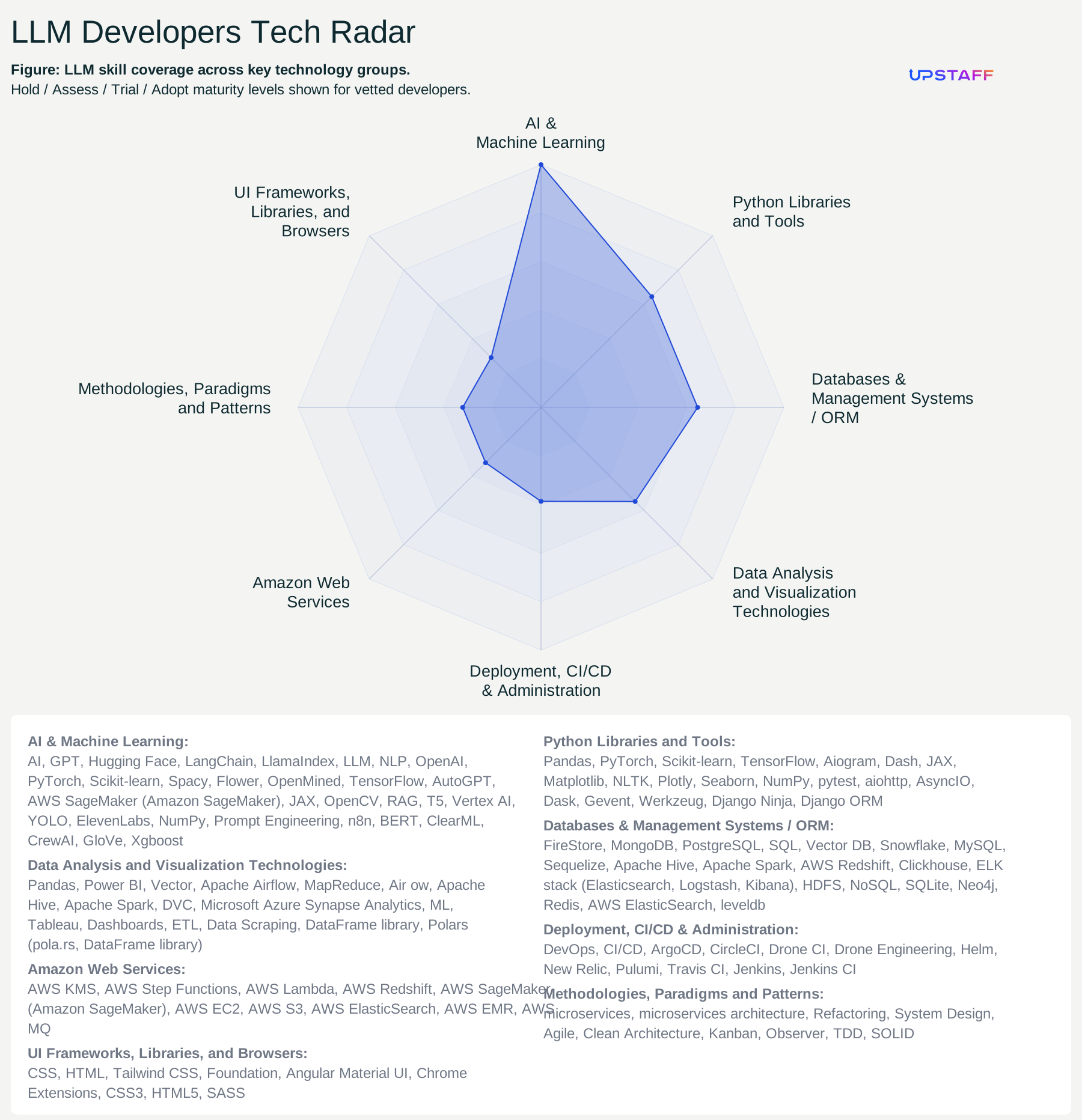
Upstaff’s platform makes it easy to find and hire LLM Engineers with the right toolkit for your project, whether leveraging BERT for semantic tasks or LLaMA for efficient agent development. Our vetted professionals are proficient in tools like PyTorch, LangChain, and AWS, delivering scalable, ethical, and innovative AI solutions. From semantic data engineering to autonomous agents, Upstaff’s advanced matching connects you with experts across these 16 roles, streamlining your hiring process and driving business success.Talk to Our Expert
Our journey starts with a 30-min discovery call to explore your project challenges, technical needs and team diversity.

Yaroslav Kuntsevych
co-CEO